
A Guardian system runs from $895 for the cellular tracker to $2,495 for the hybrid bundle with every sensor included, plus an annual service plan of $300 or $660 depending on whether you need satellite.
Those numbers cover the hardware that goes on the boat and the connection that keeps it talking to you.
The Marine Guardian builds its own systems in South Florida and has been protecting boats since 2017. Every sensor is hardwired, marine rated and corrosion resistant, because a yacht sitting at a dock in August is a harder environment than any house.
What follows is what the system does, what it does not do, and how to tell which version your vessel actually needs.
Weekdays 8AM to 5PM Eastern. No obligation.
| System | What it is | Price |
|---|---|---|
| The Guardian, Cellular | Tracker and monitoring, near shore | $895 |
| The Guardian, Hybrid | Adds 2-way Iridium satellite, global | $1,495 |
| Cellular Bundle | Hybrid hardware plus every sensor and the siren | $1,895 |
| Hybrid Bundle | Satellite plus every sensor and the siren | $2,495 |
| Service plan | Covers | Price |
|---|---|---|
| Annual Cellular | Alerts, tracking, app control over cellular | $300 / year |
| Annual Cellular and Satellite | The above plus Iridium coverage | $660 / year |
No. The Guardian is a sensor and alarm system, not a video system. There is no camera and no recording.
That is a deliberate difference, and it is worth understanding.
A camera answers the question “what happened.” You watch the footage afterward. A hardwired alarm answers a different question: it tells you something is happening right now, it makes noise loud enough to end the attempt, and it calls your phone while it is still going on.
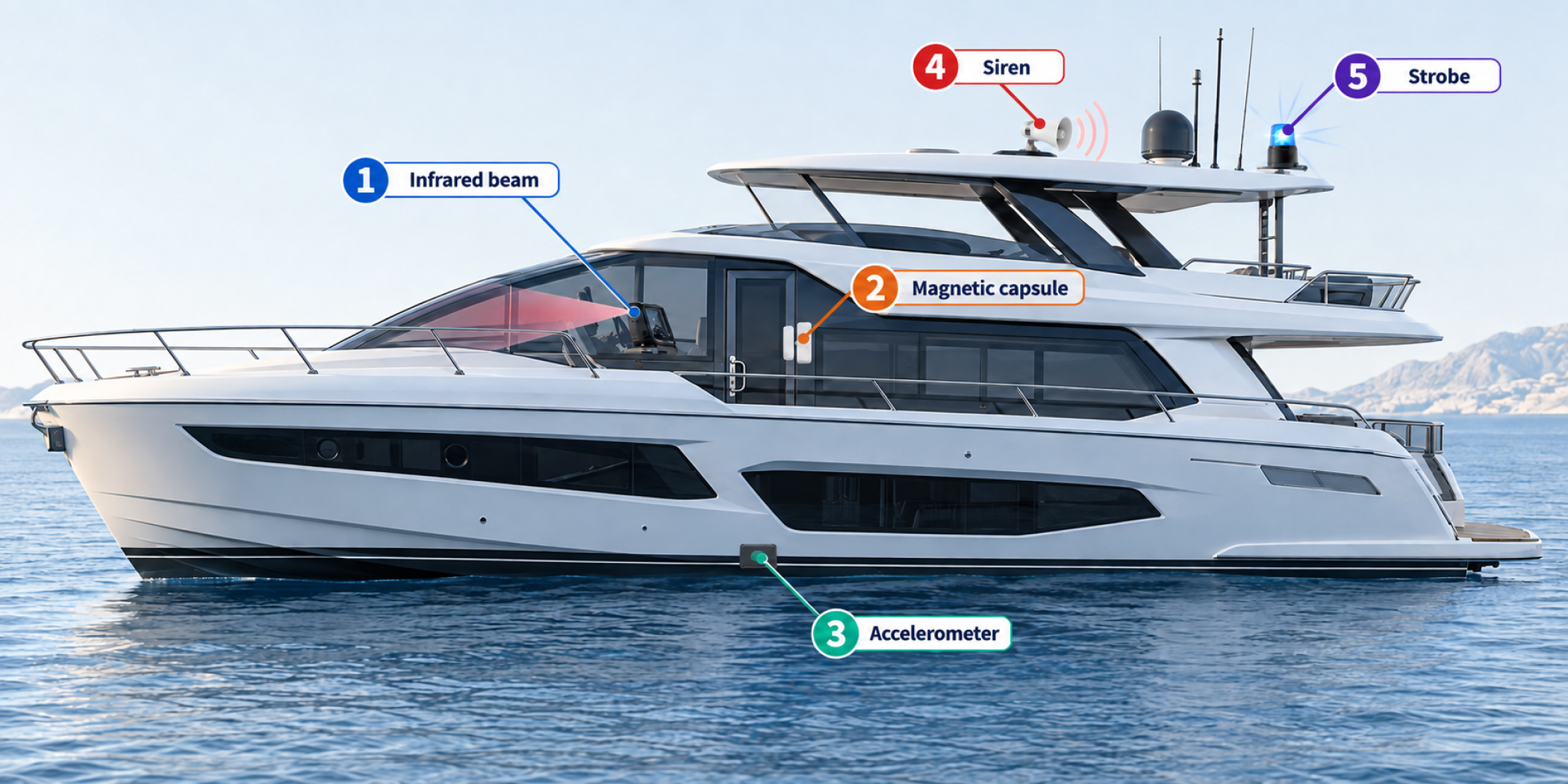
When a Guardian sensor triggers, three things happen at once. The 125 decibel siren sounds, the LED strobe fires, and the system places an automated voice call to you. Not a push notification you might miss. A phone call.
An invisible beam built for exterior use, which matters on a yacht with an open cockpit or flybridge where there is no door to put a sensor on. Positioned at the helm or an access point, it draws an invisible line from point to point, sounding an alarm and sending an alert is someone crosses it.
This is the layer that answers the searches for perimeter detection, and it is the one most consumer kits do not have.
Magnetic capsules or flush mount sensors on cabin doors, engine room hatches, lazarettes, engine cowlings, and anywhere gear is stored. Small enough to conceal, and there is no home security sensor bolted to your joinery.
The hybrid system does. It uses the Iridium two-way network of 66 low earth orbit satellites, which are cross linked and cover the entire planet, so the system keeps working in the middle of an ocean crossing.
The important word is two-way.
A one-way satellite system can tell you where the boat is once you are out of cell range, and that is all. You lose the ability to read your sensors or arm and disarm anything until cellular comes back.
Two-way means the link keeps working in both directions. You can still check the bilge sensor, still see shore power status, still arm the system, from anywhere.
On cellular the system runs on 2G, 3G and 4G LTE-M across 142 countries, including all of the Bahamas. That range matters more than it sounds. A system built only for the newest networks can go dark the moment you leave a modern coverage area, and plenty of the islands people actually cruise to are still running older networks.
Because they run on batteries that die and radio links that get stepped on. A yacht is full of things that transmit: radar, VHF, the boat in the next slip, the marina wifi.
Every Guardian sensor is wired. No sensor batteries to go flat at three in the morning, no frequency to be interfered with, and every connection is corrosion resistant and marine rated.
This is not an abstract preference. A system that cries wolf gets ignored, and then it gets switched off. The cost of false alerts is not the annoyance, it is that people stop believing them.
Many carriers offer premium discounts for a certified security and monitoring system, and some now require tracking as a condition of coverage on higher value hulls. The Guardian Hybrid is built to meet those carrier requirements.
What we will not tell you is what your discount will be. That depends on your carrier, your hull value, your cruising area and your claims history, and anybody quoting you a percentage without seeing your policy is guessing.
The practical step: ask your broker what their requirement is, in writing, before you choose between the cellular and the hybrid. If tracking is mandatory on your policy, that decision is already made.
Alerts when shore power drops and is reconnected. Losing shore power means the batteries stop charging, food in the frig goes bad, freezer items and ice thaw, and your A/C stops working. The Guardian can also trigger the alarm if the cord is pulled while the system is armed.
Continuous voltage monitoring with low battery and disconnect alerts, so you find out the house battery is low and prevent it from dying.
If your yacht lives in a staffed marina behind a gate, you are aboard most weekends, and what actually worries you is the bilge and the shore power cord, then the $895 cellular tracker with a high water sensor does the job. Around a thousand dollars, and you are covered for the failure that is most likely to happen to you.
The full bundle earns its price in three situations: the boat sits unattended for long stretches, it carries electronics worth stealing at the helm, or it leaves cellular coverage. If none of those describe your season, buy the smaller system and put the difference toward the haul out.
We recommend a local marine yard. If you have mechanical experience the install is manageable yourself, and there is a step by step How to Install video on our YouTube channel.
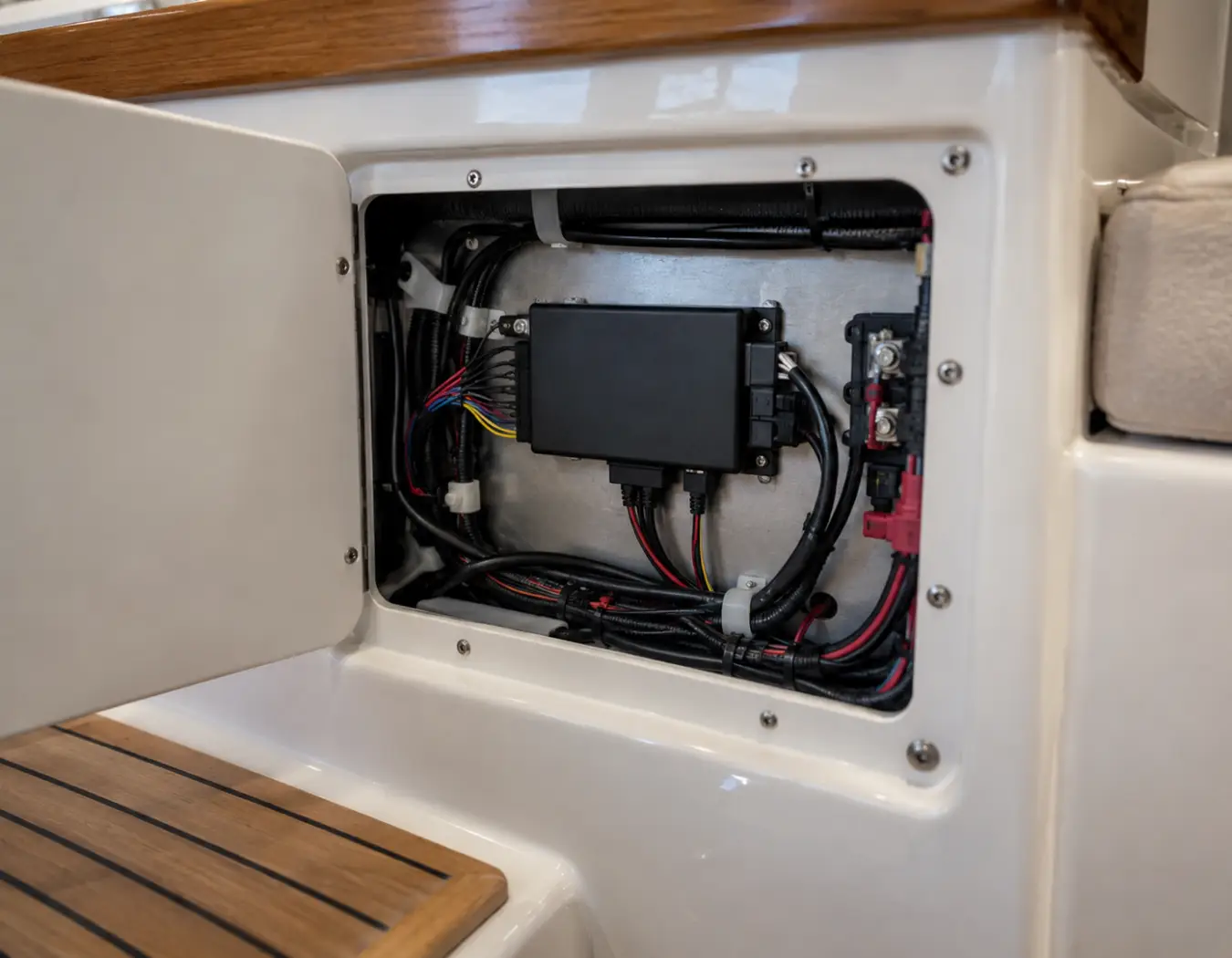
The controller is 6.5 by 5.0 by 2.0 inches and runs on 7 to 12 volts DC, small enough to conceal behind a panel. It supports up to six sensors on one unit and carries a 7000 mAh backup battery, so cutting the boat’s power does not silence it.
The unit is certified by Verizon, AT&T, Iridium, FCC, CE and IC.
The Guardian is installed on boats of all sizes, from center consoles to larger cruising yachts. Six sensor inputs is the limit on a single controller, which covers most vessels comfortably.
If you need more coverage than six sensors, or you are looking at several boats under one account, call us and we will map it out rather than sell you the wrong configuration.
Yes. The service plan is annual and renews on the anniversary of your signup date. Without an active plan the device cannot send alerts or report its position.
Have a question? A Marine Guardian specialist will get right back to you.
Prefer to talk? Call 800-397-9807